

Disclosure Management
Software – CCH Tagetik
Book a Disclosure Management Demo
Narrative + numbers, one platform · ESEF/iXBRL native · ESMA-validated output · Platinum Partner
Our solutions

Disclosure Management
Automate all checks and balances, while
normalizing and validating data.
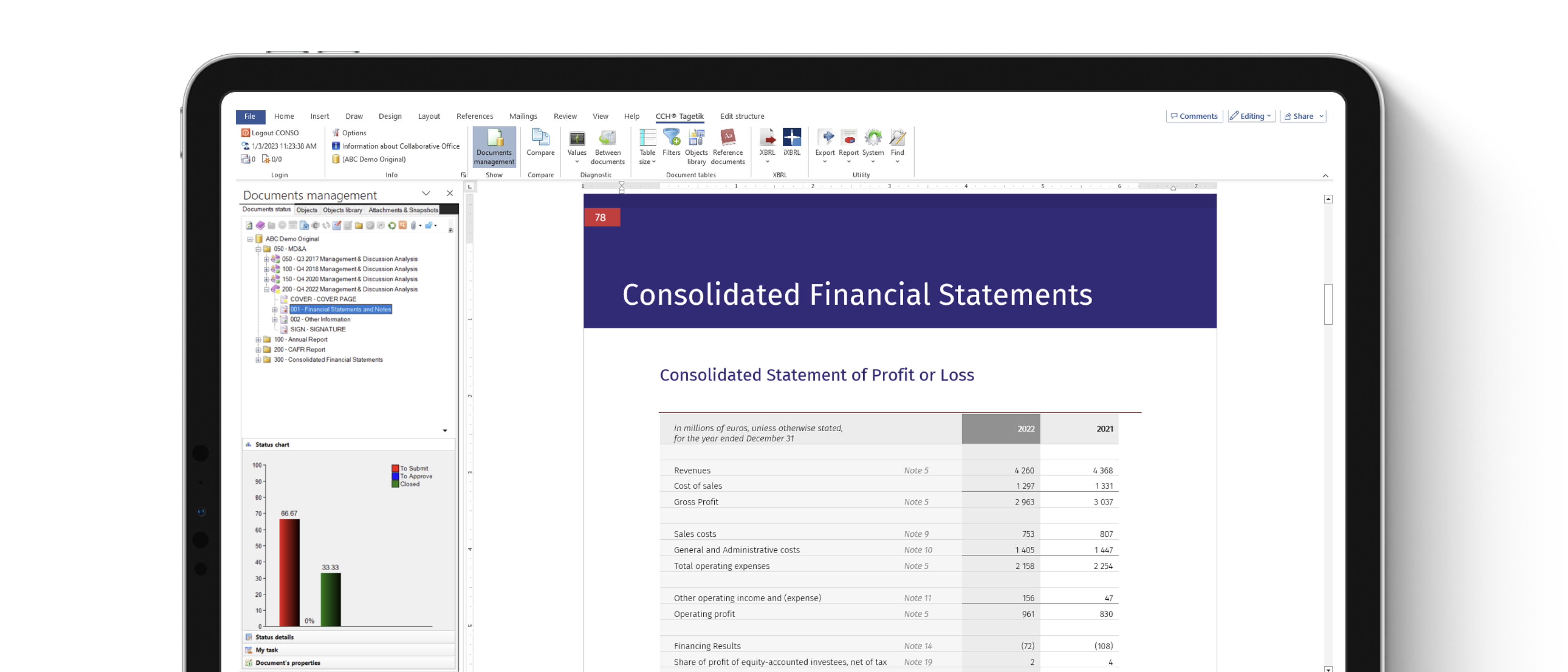
Intuitive. Comprehensive. Real time. Easy to understand. This solution combines qualitative and quantitative data seamlessly, unifies decentralized teams, eliminates data integrity issues, standardizes your forms, graphics, and messages in a comprehensive package. Financial reporting and disclosure management at your fingertips, all on one platform, across all your devices, in real time.
Why Report Production Still Breaks at the Last Mile
The numbers are final. The consolidation is done. And yet the annual report still takes weeks: narrative sections drafted in Word, tables pasted from Excel, last-minute adjustments that force every figure to be re-checked manually across 200 pages. One late journal entry, and the document is out of sync with the financials again.
Disclosure management software closes this gap. With CCH Tagetik, narrative reports are connected directly to live financial data – when a number changes in the consolidation, it changes in the report. Automatically, everywhere, with a full audit trail.
What CCH Tagetik Disclosure Management Delivers
Disclosure management is where financial reporting either holds together or falls apart. The difference between platforms is not how the finished report looks – it is what happens between the last consolidation adjustment and the filing deadline, when numbers change and dozens of pages need to change with them.
Narrative connected to live financial data
Annual reports, board packs and regulatory filings pull figures directly from the same governed data used for consolidation. No copy-paste, no version drift between the financials and the document – every number in the report traces back to its source.
Version control and audit-ready workflows
Multiple contributors – finance, legal, investor relations – work on the same document with controlled sections, approval workflows and a complete change history. Auditors see exactly who changed what, when, and why.
ESEF and iXBRL Reporting – Tagged, Validated, Filing-Ready
For EU-listed companies, the annual financial report is not finished when the numbers are approved – it still has to be published in ESEF format, with the financial statements tagged in iXBRL and validated against ESMA rules before filing. For most reporting teams, this is where the timeline gets tight: tagging usually starts only after the report is final, and every late change means going back over the tags.
What is ESEF reporting?
ESEF – the European Single Electronic Format – is the mandatory reporting format for annual financial reports of EU-listed companies. Under the ESMA Regulatory Technical Standard, issuers must publish their annual financial report in XHTML, with the primary financial statements tagged in iXBRL (Inline XBRL) according to the ESEF taxonomy. Consolidated IFRS statements require detailed tagging of the income statement, balance sheet, cash flow statement and statement of changes in equity, plus block tagging of the notes.
iXBRL tagging inside the reporting process
Most organizations treat ESEF as a separate step: the report is produced first, then sent to an external tagging service or a standalone tool, usually days before the filing deadline. Every late change to the financials means re-tagging – and re-checking.
CCH Tagetik handles iXBRL tagging inside the same environment used to produce the report. Tags are attached to the underlying data, not to a static document, so when a figure changes the tagging follows it. There is no hand-off, no external tagging service, and no last-minute conversion window.
ESMA validation and filing
The tagged report is validated against ESMA rules before filing – taxonomy conformance, anchoring of extension elements, and structural checks – so errors surface during preparation rather than at submission. The output is a filing-ready ESEF package, generated from governed financial data with a complete audit trail from tag back to source.
Choosing a disclosure management platform is a decision you live with for the next 5–10 years
Workiva, Certent CDM, SAP Disclosure Management, CCH Tagetik — on a demo, they all produce a polished report. The real differences appear in how they handle your reporting reality: live connection to financial data, ESEF/iXBRL tagging, multi-contributor workflows, and what happens when a number changes the night before filing.
 Platform Selection
 Reporting Process Design
 Project Management
 Data Integration
Before you commit to a platform, you should know exactly how it will handle your disclosure and reporting processes. We help you find out – with proof, not promises.
Migrating from SAP Disclosure Management or IBM Cognos DM
If your reporting team still runs SAP Disclosure Management or IBM Cognos Disclosure Management (now Certent CDM), you are producing your most visible documents – annual reports, regulatory filings – on platforms with an uncertain future. SAP DM is no longer a strategic product in the S/4HANA roadmap, and Cognos DM has changed hands twice since IBM divested it.
CCH Tagetik is a natural migration destination: disclosure management is delivered within the same platform as consolidation and planning, narrative and numbers stay connected by design, and ESEF/iXBRL requirements are handled natively.
Inulta supports disclosure management migrations end-to-end – mapping existing report structures, preserving document templates and workflows, and running the first live reporting cycle in parallel to guarantee continuity.
Disclosure Management Implementation – Live with Inulta
Disclosure management touches the most visible documents a company produces – which means implementation quality is non-negotiable. Inulta – CCH Tagetik Platinum Implementation Partner and Best EPM Implementation Partner 2026 – has delivered disclosure and reporting transformations as part of 250+ enterprise projects, connecting report production to consolidation data so the last mile of reporting is as governed as the close itself.
Disclosure Management Across Industries




Frequently Asked Questions
What is disclosure management?
Disclosure management is the process of producing, reviewing and publishing external financial reports – annual reports, regulatory filings, board documents – with controlled workflows and data that stays consistent with the underlying financial systems. It covers the “last mile” of financial reporting: turning finalized numbers into audited, formatted, filed documents.
What is disclosure management software?
Disclosure management software connects narrative report documents directly to governed financial data, so figures update automatically when the source changes. It adds version control, multi-contributor workflows, approval processes and regulatory tagging (such as ESEF/iXBRL) – replacing the Word-and-Excel copy-paste process that makes report production slow and error-prone.
What is the best disclosure management software?
The leading disclosure management platforms include CCH Tagetik, Workiva, Certent CDM (insightsoftware) and SAP Disclosure Management. CCH Tagetik – developed by Wolters Kluwer – delivers disclosure management within the same unified platform as financial consolidation and planning, which keeps narrative and numbers connected by design rather than through integrations.
What is ESEF reporting?
ESEF (European Single Electronic Format) is the mandatory electronic reporting format for annual financial reports of companies listed on EU regulated markets. Issuers must publish their annual financial report in XHTML, with primary financial statements tagged in iXBRL according to the ESEF taxonomy defined by ESMA. Notes to the consolidated financial statements must be block-tagged.
What is iXBRL?
iXBRL (Inline XBRL) is a format that embeds machine-readable XBRL tags inside a human-readable XHTML document. This means one file serves both purposes: people read the report as a normal document, while regulators and analysts extract structured financial data automatically from the embedded tags. iXBRL is the format required for ESEF filings in the EU and for statutory filings in several other jurisdictions.
Does CCH Tagetik support ESEF and iXBRL tagging?
Yes. CCH Tagetik manages ESEF and iXBRL tagging natively, within the same environment used to produce the annual financial report. Tags are applied to the underlying data rather than to a static document, so figures and tags stay synchronized when numbers change. The tagged report is validated against ESMA rules before filing, producing a filing-ready ESEF package without separate tagging tools or external tagging services.
Who has to file in ESEF format?
All issuers with securities listed on EU regulated markets must prepare their annual financial reports in ESEF. Companies reporting under IFRS on a consolidated basis must tag their primary financial statements in detail and block-tag the notes. Issuers that do not prepare consolidated IFRS statements must still publish in XHTML but without the detailed tagging requirement.
Can ESEF tagging be outsourced to a tagging service?
It can – many companies use external iXBRL tagging services. The trade-off is timing and control: the report has to be finalized before tagging starts, every late change requires re-tagging, and the tagged output has to be reconciled back against the source financials. Managing tagging inside the disclosure management platform removes the hand-off entirely, because tags are attached to live data rather than to a finished document.
Can CCH Tagetik replace SAP Disclosure Management?
Yes. With SAP Disclosure Management no longer a strategic product in SAP’s S/4HANA roadmap, many organizations migrate to CCH Tagetik for report production – often while keeping SAP as their ERP. CCH Tagetik integrates with SAP as a data source and manages disclosure, consolidation and regulatory reporting in one environment.
Can CCH Tagetik replace IBM Cognos Disclosure Management (Certent CDM)?
Yes. IBM Cognos Disclosure Management was divested by IBM and has changed ownership twice – creating uncertainty for its user base. CCH Tagetik is a common migration destination: report structures, templates and workflows are mapped into the new environment, and the first live reporting cycle typically runs in parallel to guarantee continuity.
How does disclosure management connect narrative and financial data?
In CCH Tagetik, report documents contain live links to the underlying financial data model — the same data used for consolidation. When a figure changes at source, every instance in the report updates automatically, with a full audit trail. This eliminates version drift between the financial statements and the narrative document.
How long does a disclosure management implementation take?
A focused disclosure management implementation typically takes 12-16 weeks with an experienced partner, depending on the number of report types, contributors and regulatory requirements. Implementations are usually timed to go live ahead of an annual reporting cycle, with the first cycle run in parallel with the legacy process.

Need a custom solution tailored just for you?
Contact us and we will offer our full experience to solve all your business needs in no time.
Contact us here below