

Supply Chain Planning
Software – CCH Tagetik
Book a Supply Chain Planning Demo
AI-based demand, supply and inventory planning · Connected to your financial plan · 250+ projects · Platinum Partner
Our solutions

Supply chain Management
Connect demand, supply, production, and sales and operations
planning for a 360° view of your supply chain.
Power up supply chain planning performance to improve forecast accuracy, increase resilience, and drive growth.This enterprise-wide solution dynamically updates plans and instantly shows you the ripple effect of any customer, product or supplier change. With real-time data, scenario analysis, and the AI to create accurate predictive forecasts, you can assess strategic, financial and operational impacts across the entire integrated business plan, and cross-functional teams can collaborate to prepare your business for anything.
Why Operational Plans and Financial Plans Drift Apart
In most organizations, the supply chain plan and the financial plan are built by different teams, in different systems, on different assumptions – and reconciled afterwards, if at all.
Operations plans in units: how much to produce, how much to hold, when to order. Finance plans in currency: revenue, margin, working capital, cash. When demand shifts or a supplier fails, operations replans quickly. Finance finds out at month end, when the variance appears in the numbers and it is too late to influence the decision.
The cost is not the reconciliation work, although that is real. It is that operational decisions get made without visibility into their financial consequences – and financial commitments get made without knowing whether operations can deliver them.
Supply chain planning software closes that gap when it shares a data model with financial planning: a change in demand, supply or production immediately shows its effect on revenue, margin and cash, in the same environment where the plan is built.
What CCH Tagetik Supply Chain Planning Delivers
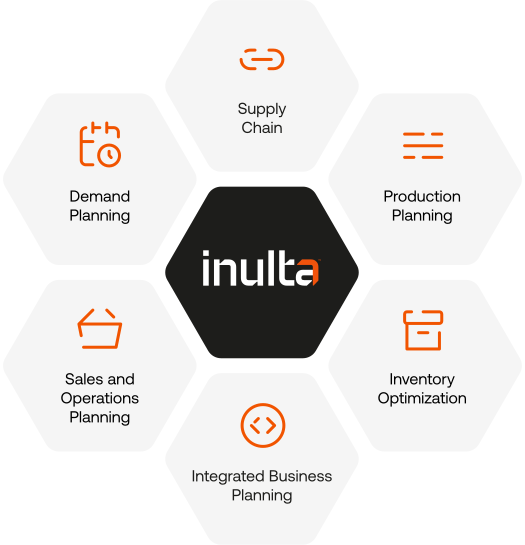
Supply chain planning covers five connected processes. What determines whether they work together is not the sophistication of each one, but whether they run on the same data.
Demand planning and forecasting
A consolidated view of demand across facilities, product families and lines of business. AI-based forecasting factors in promotions, advertising, new product introductions, seasonality and competitor actions – and allows rapid pivots when those drivers change. Forecast accuracy matters disproportionately here: production schedules, inventory targets and working capital projections are all built on it.
Supply planning and production planning
Building supply plans that hold up against unanticipated costs, seasonal spikes and unexpected demand – with AI-based capacity planning, product planning, MRP and production scheduling. Production planning draws decision intelligence from SKUs, bills of materials, distribution centres and customer data to improve turnover, protect margins and prevent stock-outs.
Inventory optimization (MEIO)
Multi-Echelon Inventory Optimization (MEIO) balances inventory across the entire distribution network — the right product, in the right place, at the right time, without over- or understocking. Inventory is where operational decisions become working capital decisions, which is why it belongs in the same model as the financial plan.
Sales and operations planning (S&OP)
The recurring process where commercial, operations and finance agree on a single plan. CCH Tagetik synchronises departmental plans, operational activities and supply chain data – surfacing manufacturing bottlenecks and delivery issues while there is still time to act on them. The value depends on cycle time: an S&OP process that takes three weeks to prepare arrives after the decisions have already been made.
Scenario modelling and risk analysis
Modelling alternative futures – a supplier failure, a demand spike, a cost increase, a capacity constraint – and cascading each one through demand, supply and replenishment for end-to-end impact. Sensitivity analysis identifies which risk factors matter most. Because scenarios run against the same model as the base plan, results are directly comparable rather than assembled separately.
AI across the planning cycle
AI runs underneath the planning processes above rather than sitting beside them as a separate feature. Forecasts are generated through probabilistic modelling instead of single-point estimates: each figure carries a replenishment range and a confidence score, so planners see the likely spread of outcomes and how much weight to place on any given number. The AI models account for exceptions, fill gaps where data is incomplete, and track their own accuracy against actual results over time – which makes forecast quality measurable rather than assumed.
Supply Chain Planning Connected to Financial Planning
This is where CCH Tagetik differs from specialist supply chain platforms.
Platforms like Kinaxis, o9 and Blue Yonder were built to optimise the supply chain itself: network design, constraint solving, execution. They answer operational questions in operational terms. Translating those answers into revenue, margin and cash happens afterwards – in another system, usually by another team.
CCH Tagetik starts from the financial side. It is a planning platform that extends into supply chain operations, which means demand, supply and inventory plans sit in the same data model as budgeting, forecasting and consolidation. A scenario evaluated in operational terms is evaluated in financial terms at the same moment, with no hand-off between them.
The two approaches suit different questions. If the problem is how to optimise a complex distribution network, a specialist platform is the right tool. If the problem is what an operational decision does to the financial plan – and who has to explain that to the board – connected planning is.
The same data model carries budgeting, planning and forecasting and financial close and consolidation – which is why a supply chain scenario in CCH Tagetik produces financial results directly, rather than requiring a translation step in another system.

Reduced backorders by 84%
The innovative approach to aligning sales and demand data
with forecasting models to feed predictive analytics greatly
advanced our ability to accommodate demand spikes.
Jody Rogers, CPIM CSCP,
Director Global Supply Chain at Charles River

Choosing a supply chain planning platform is a decision you live with for the next 5 – 10 years
Kinaxis, o9, Blue Yonder, SAP IBP, CCH Tagetik – on a demo, they all produce a plan. The real differences appear in what the plan connects to: whether operational scenarios translate automatically into financial impact, how much data preparation the platform demands before it delivers value, and whether finance and operations end up working in one model or two.
 Platform Selection
 Planning Process Design
 Project Management
 Data Integration
Before you commit to a platform, you should know exactly how it will connect your operational plans to your financial ones. We help you find out – with proof, not promises.
Supply Chain Planning Implementation – Live with Inulta
Supply chain planning implementations are constrained by data before they are constrained by anything else. Historical demand at the right granularity, product master data that is consistent across systems, supply constraints that are documented rather than known informally – these determine the timeline more than the configuration work does.
Inulta – CCH Tagetik Platinum Implementation Partner and Best EPM Implementation Partner 2026 – approaches supply chain planning as an extension of the financial planning architecture rather than a separate project. Our consultants assess data readiness first, establish one planning process reliably, then extend scope.
Supply Chain Planning Across Industries

Manufacturing
production planning, capacity constraints, MRP and inventory across plants, connected to the financial plan

Retail
demand planning across store networks and channels, with inventory as a working capital decision

Pharma &
Life Sciences
supply planning under regulatory constraints, with long lead times and expiry management

Energy &
Utilities
commodity planning and scenario modelling under price volatility
Frequently Asked Questions
What is supply chain planning software?
Supply chain planning software is used to forecast demand, plan supply and production, manage inventory levels and run the sales and operations planning process. Unlike execution systems that manage transactions – warehouse management, transportation management – planning software works forward: it models what should happen, tests alternatives, and produces the plan that operations and finance work against.
What is the difference between supply chain planning and supply chain management?
Supply chain management is the broader discipline, covering everything from sourcing and procurement through production, warehousing, transportation and delivery. Supply chain planning is the forward-looking part: deciding what to produce, purchase and hold, and when. Planning platforms and execution systems serve different purposes and are usually separate, with planning outputs feeding execution.
What is S&OP (sales and operations planning)?
Sales and operations planning is the recurring process – usually monthly – in which commercial, operations and finance teams agree on a single plan: what demand is expected, what supply and production capacity can deliver, and what the financial consequences are. Its purpose is to resolve the conflicts between those three views before they become operational problems.
What is integrated business planning (IBP)?
Integrated business planning extends S&OP to cover the full business plan, connecting demand, supply, production and commercial plans directly to the financial plan. The distinguishing feature is that operational assumptions and financial outcomes live in the same model – so a change in demand or supply immediately shows its effect on revenue, margin and cash, rather than being translated into financial terms afterwards.
What is the difference between S&OP and IBP?
S&OP is primarily an operational alignment process, focused on balancing demand and supply, with a financial review attached at the end. Integrated business planning treats the financial plan as part of the same model rather than a downstream consequence: scenarios are evaluated on operational and financial impact together. In practice most organizations progress from S&OP toward IBP as their planning data and processes mature – the distinction is less a product category than a level of integration.
What is demand planning?
Demand planning is the process of forecasting what customers will buy, by product, channel and period. It combines statistical forecasting on historical data with commercial input on promotions, launches and known market changes. Everything downstream depends on it – production schedules, inventory levels, working capital – so forecast error propagates through the whole plan.
How does supply chain planning connect to financial planning?
When operational and financial plans share a data model, the effect of an operational change – a supplier delay, a demand spike, a capacity constraint – appears immediately in revenue, margin and cash flow projections rather than being calculated afterwards in a separate system. This is the main reason finance functions take an interest in supply chain planning platforms, and the main difference between platforms built for supply chain optimization and platforms built for connected planning.
Does CCH Tagetik support supply chain planning?
Yes. CCH Tagetik extends its financial planning platform into operational planning, covering demand planning, supply and inventory planning, sales and operations planning, and scenario analysis. Because these run on the same data model as budgeting, forecasting and consolidation, operational scenarios are evaluated in financial terms without a separate translation step.
What is scenario planning in supply chain management?
Scenario planning is the practice of modelling alternative futures – a supplier failure, a demand shift, a cost increase – and comparing their operational and financial impact before deciding how to respond. Its value depends on speed: a scenario that takes two weeks to model arrives after the decision has already been made.
What is multi-echelon inventory optimization (MEIO)?
Multi-echelon inventory optimization balances stock across every level of a distribution network – central warehouses, regional distribution centres, local sites – rather than optimising each location in isolation. Optimising one echelon at a time typically produces either excess stock or shortages elsewhere, because the levels are interdependent. MEIO models the network as a whole, which is what allows inventory to be reduced without lowering service levels.
Was CCH Tagetik Supply Chain Planning previously called Vanguard Predictive Planning?
Yes. CCH Tagetik Supply Chain Planning was formerly Vanguard Predictive Planning, acquired by Wolters Kluwer and integrated into the CCH Tagetik platform. Organizations that know the product under its previous name are using the same underlying solution, now connected to CCH Tagetik’s financial planning and consolidation capabilities.
How long does a supply chain planning implementation take?
A focused implementation covering demand planning or S&OP for a defined scope typically takes several months, driven mainly by data readiness – the quality and granularity of historical demand, product master data and documented supply constraints. Broader integrated business planning programmes are usually phased, establishing one planning process first and extending scope once it runs reliably.

Need a custom solution tailored just for you?
Contact us and we will offer our full experience to solve all your business needs in no time.
Contact us here below